PRODUCTS
Thin layer chromatography equipment
+ infoProfessional thin layer chromatography equipment for laboratory analysis
Thin layer chromatography equipment provides laboratories with reliable tools for the separation, identification and qualitative analysis of chemical compounds. Used extensively in pharmaceutical, chemical, food and research laboratories, TLC equipment delivers rapid and cost-effective analytical results.
Fungilab offers a complete range of thin layer chromatography equipment, including high-quality TLC chambers designed to provide optimal solvent saturation and reproducible chromatographic separations for routine and advanced laboratory applications.
Manufactured with precision and chemical-resistant materials, Fungilab chromatography equipment helps laboratories achieve consistent analytical performance while supporting research, quality control and method development.
Our products
Viscolead Series
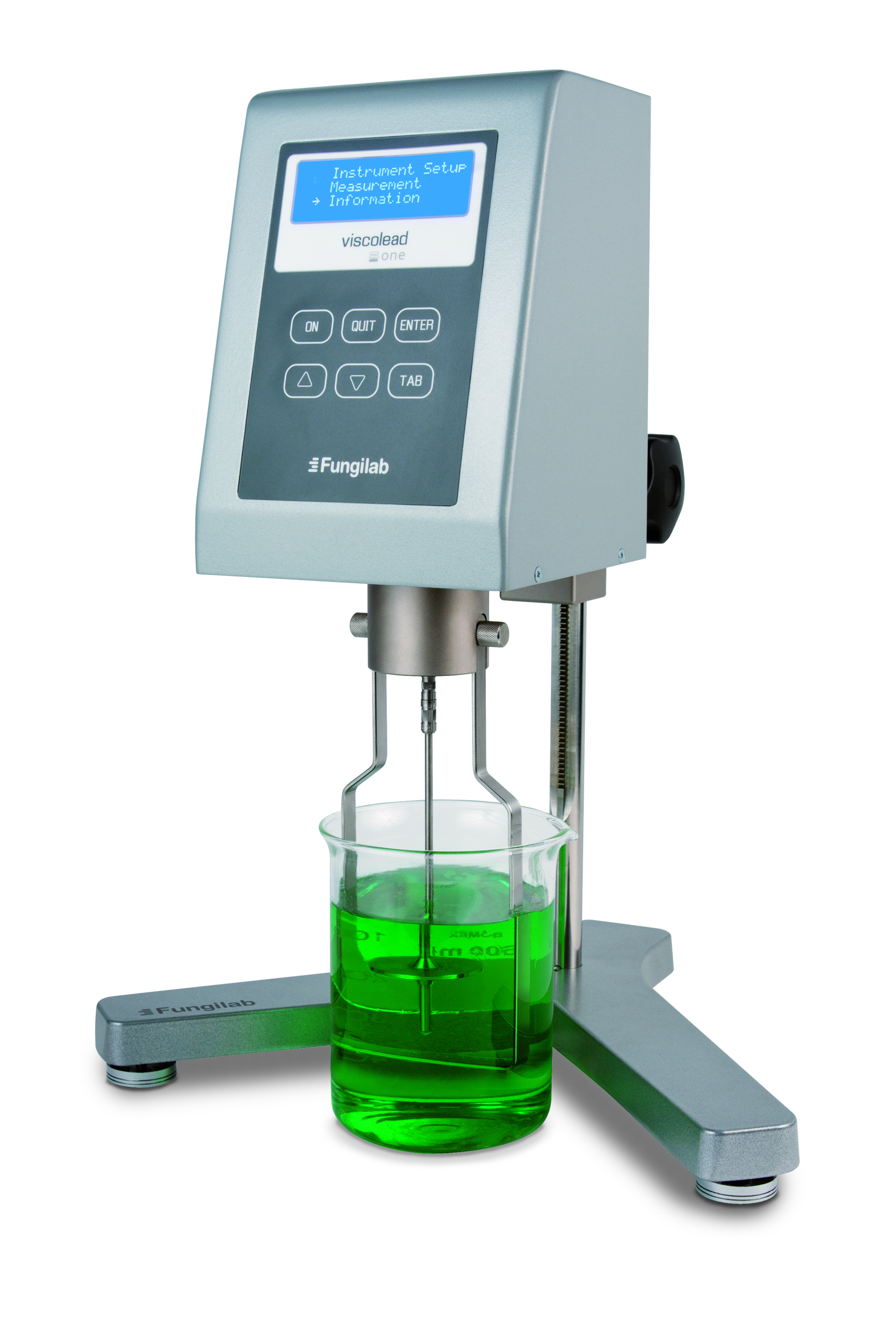
Viscolead ONE
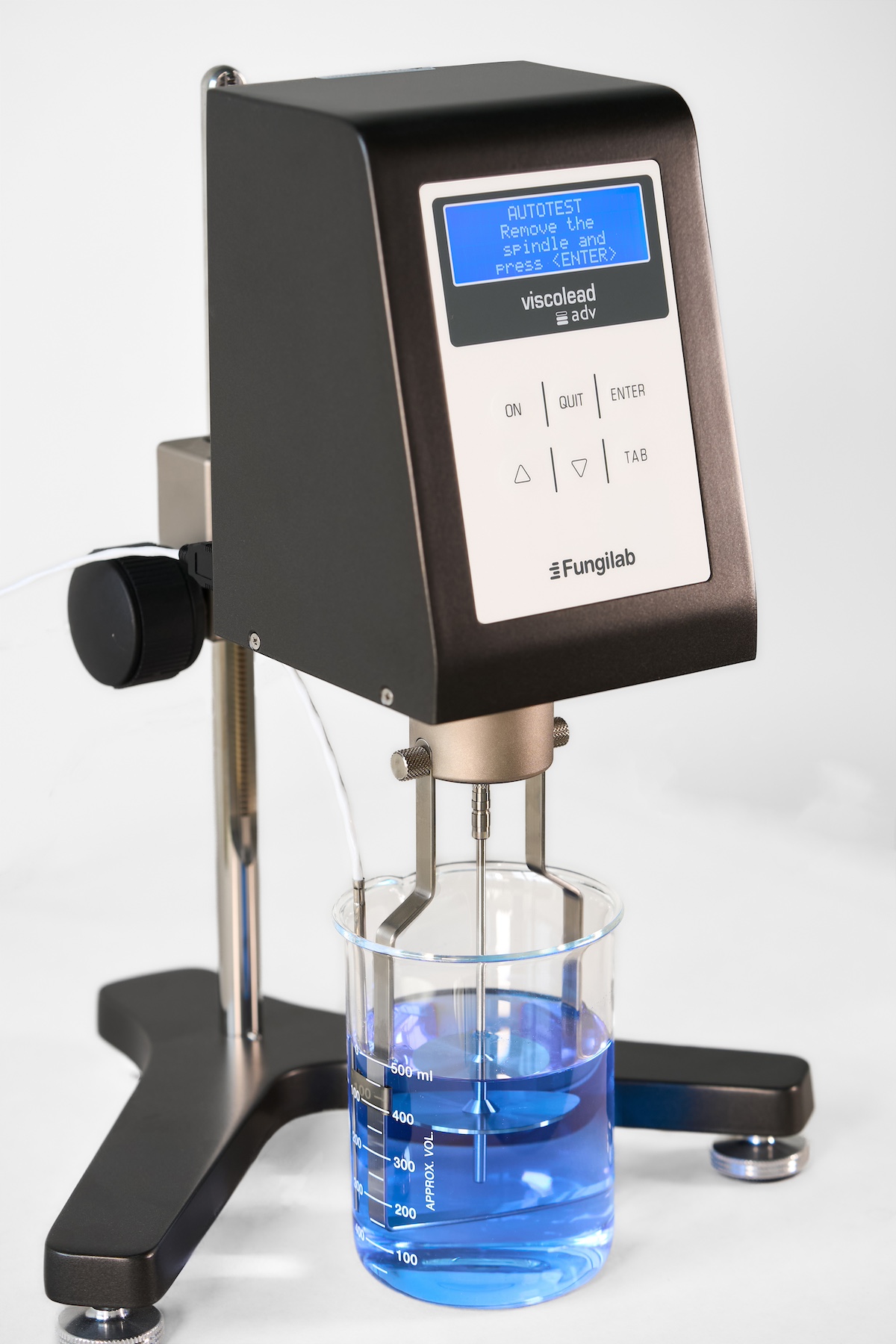
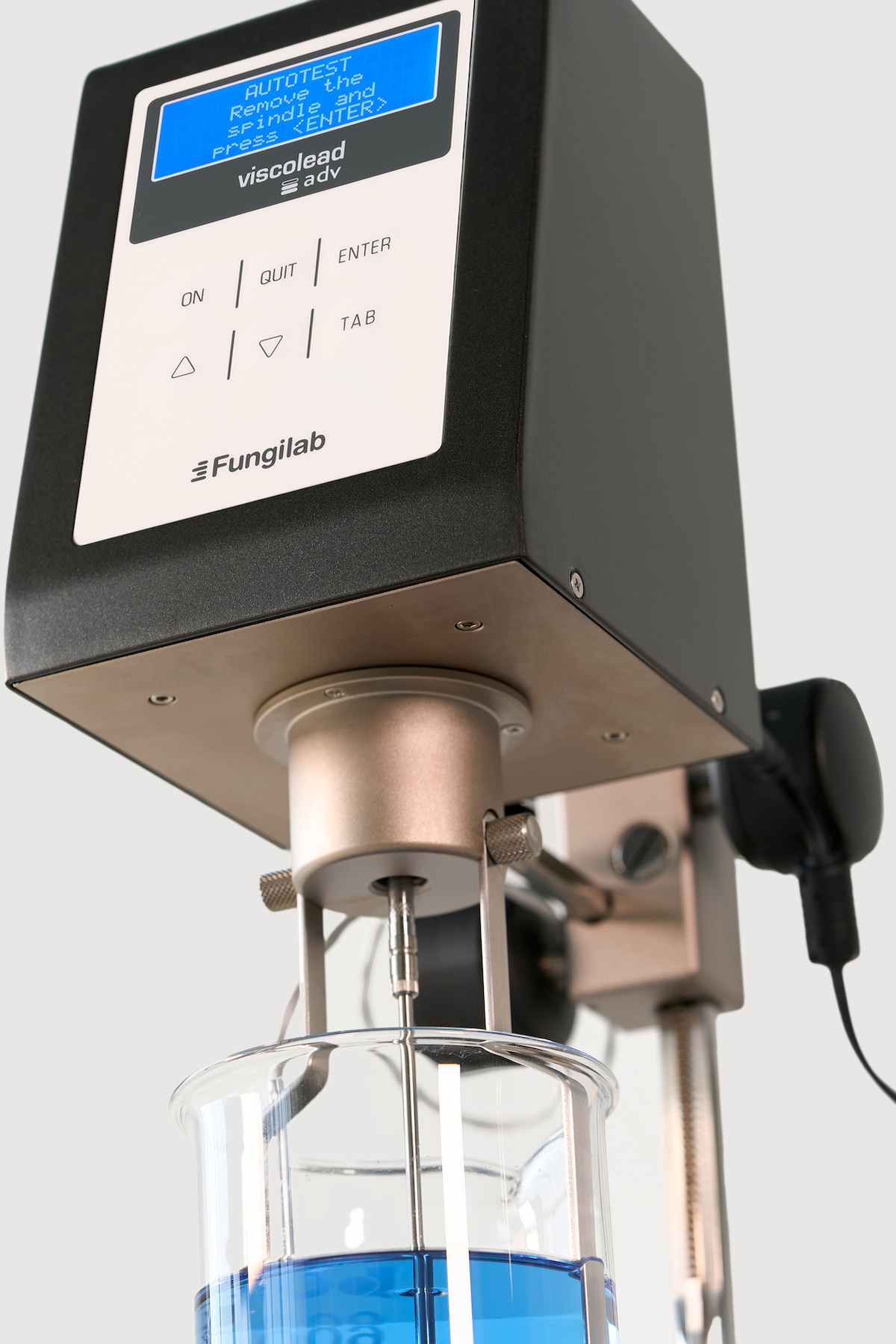
Viscolead ADV
Accessories
LABORATORY DIVISION
Dynamic viscosity
Viscosity is part of the science of Rheology which quantifies the resistance materials give to changing shape.
Proper interpretation of viscosity data can reduce the rate of rejects while keeping production and formulation development costs to a minimum. Consistent product quality is ensured through proper viscosity measurements, either alone or in conjunction with compatible tests.
Dynamic viscosity testing can help with:
- Material characterization or “finger-printing”
- Standard testing methods to check for differences between batches
- Indirect way of measuring quality
- Product formulation
- Quality control
- Process control
- Design, optimization and operation of process equipment
Material characterization or “finger-printing”
Standard testing methods to check for differences between batches
Indirect way of measuring quality
Product formulation
Quality control
Process control
Design, optimization and operation of process equipment
Viscosity types
Dynamic viscosity
Centipoise (mPa*s)
Kinematic viscosity
Centistokes (mm2/sec)
Apparent viscosity
Centipoise (mPa*s)
Newton’s Law
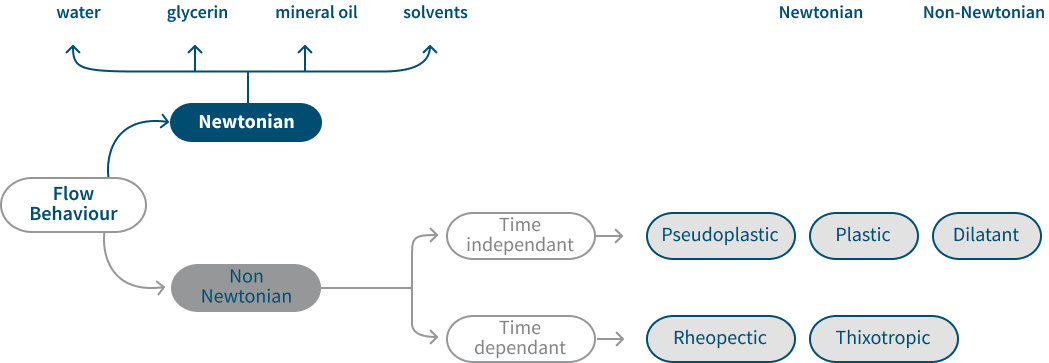
According to Newton’s law, the viscosity of a fluid is constant. As shear rate changes, shear stress changes in proportion such that viscosity is constant. Common fluids that exhibit such behavior are:
Unfortunately for us, not all fluids follow Newton’s law. In fact, most fluids do not. For this reason, fluids are classified into two categories:
Rotational Viscometer
The viscosity is calculated from the measured torque and rotational speed, as well as the dimensions of the measuring geometry.
A fluid’s resistance to flow is measured by the torque it exerts on the rotating shaft of the viscometer.
Absolute viscosity: the measuring geometry fulfills certain requirements (which is the case of coaxial spindles).
Relative viscosity: the dimensions of the measuring geometry are not well defined.
Advantage
Flexibility in:
- Viscosity Range
- Temperature range
- Shear rate range
Application
For Newtonian and non-Newtonian substances and temperatures different from room temperature.
Complete thin layer chromatography equipment for professional laboratories
Thin layer chromatography equipment includes the instruments and accessories required to perform planar chromatographic separations efficiently and reproducibly. Proper equipment allows laboratories to obtain accurate compound separation while maintaining consistent solvent development conditions.
Essential TLC laboratory equipment
- TLC chambers for controlled chromatographic development.
- Developing chambers for different TLC plate sizes.
- Glass chambers with precision-ground lids for improved solvent saturation.
- Accessories for routine chromatography workflows.
Applications of thin layer chromatography
- Pharmaceutical quality control.
- Chemical analysis.
- Food safety laboratories.
- Cosmetic formulation testing.
- Academic teaching laboratories.
- Research and development.
- Method validation.
- Identification of unknown compounds.
Advantages of professional TLC equipment
High-quality thin layer chromatography equipment ensures reproducible solvent migration, reliable Rf values and improved separation efficiency. Proper chamber sealing minimises solvent evaporation while maintaining a saturated atmosphere throughout the chromatographic development process.
Laboratory performance
- Excellent solvent resistance.
- Robust laboratory construction.
- High reproducibility between analyses.
- Suitable for routine and research applications.
- Available for multiple TLC plate formats.
- Easy cleaning and long service life.
Why choose Fungilab TLC equipment?
Fungilab combines decades of laboratory instrumentation expertise with precision manufacturing to provide reliable thin layer chromatography equipment suitable for demanding analytical laboratories. Its TLC chambers deliver consistent chromatographic conditions that support accurate analytical results across a wide range of industries.
Frequently asked questions about the Viscolead ADV
What is thin layer chromatography equipment?
Thin layer chromatography equipment includes the chambers and laboratory accessories used to perform TLC separations for analytical and quality control applications.
What is the purpose of a TLC chamber?
A TLC chamber creates a saturated solvent atmosphere that allows the mobile phase to migrate uniformly across the TLC plate, improving separation quality and reproducibility.
Which industries use thin layer chromatography?
TLC is widely used in pharmaceutical, chemical, food, cosmetic and academic laboratories for compound identification and quality control.
Why is solvent saturation important in TLC?
Proper solvent saturation reduces evaporation, improves solvent migration and produces more reproducible chromatographic separations.
Can TLC equipment be used for routine quality control?
Yes. Thin layer chromatography remains a fast, reliable and economical technique for routine laboratory analysis and quality control.
What materials are Fungilab TLC chambers made from?
Fungilab TLC chambers are manufactured from high-quality glass with precision-ground surfaces that provide excellent sealing and chemical resistance.
What are the benefits of professional TLC equipment?
Professional equipment improves analytical reproducibility, enhances solvent control, provides long service life and supports reliable chromatographic results.
Why choose Fungilab thin layer chromatography equipment?
Fungilab offers durable, precision-manufactured TLC equipment designed to deliver consistent chromatographic performance for laboratories performing routine and advanced analytical work.