PRODUCTS
Cannon-Fenske Routine
+ infoCannon-Fenske Routine capillary viscometers
Cannon-Fenske Routine capillary viscometers are designed for accurate kinematic viscosity measurements of transparent Newtonian liquids. Their simple and reliable design makes them one of the most widely used glass capillary viscometers for laboratory testing, quality control and research applications.
Manufactured from high-quality borosilicate glass, Fungilab Cannon-Fenske Routine viscometers comply with internationally recognised ASTM, ISO and UNE standards and are individually calibrated to ensure accurate and repeatable viscosity measurements.
Each viscometer is supplied with an individual calibration certificate, providing full measurement traceability and confidence in laboratory results.
Our products
Viscolead Series
Viscolead ONE
Viscolead ADV
Accessories
LABORATORY DIVISION
Dynamic viscosity
Viscosity is part of the science of Rheology which quantifies the resistance materials give to changing shape.
Proper interpretation of viscosity data can reduce the rate of rejects while keeping production and formulation development costs to a minimum. Consistent product quality is ensured through proper viscosity measurements, either alone or in conjunction with compatible tests.
Dynamic viscosity testing can help with:
- Material characterization or “finger-printing”
- Standard testing methods to check for differences between batches
- Indirect way of measuring quality
- Product formulation
- Quality control
- Process control
- Design, optimization and operation of process equipment
Material characterization or “finger-printing”
Standard testing methods to check for differences between batches
Indirect way of measuring quality
Product formulation
Quality control
Process control
Design, optimization and operation of process equipment
Viscosity types
Dynamic viscosity
Centipoise (mPa*s)
Kinematic viscosity
Centistokes (mm2/sec)
Apparent viscosity
Centipoise (mPa*s)
Newton’s Law
According to Newton’s law, the viscosity of a fluid is constant. As shear rate changes, shear stress changes in proportion such that viscosity is constant. Common fluids that exhibit such behavior are:
Unfortunately for us, not all fluids follow Newton’s law. In fact, most fluids do not. For this reason, fluids are classified into two categories:
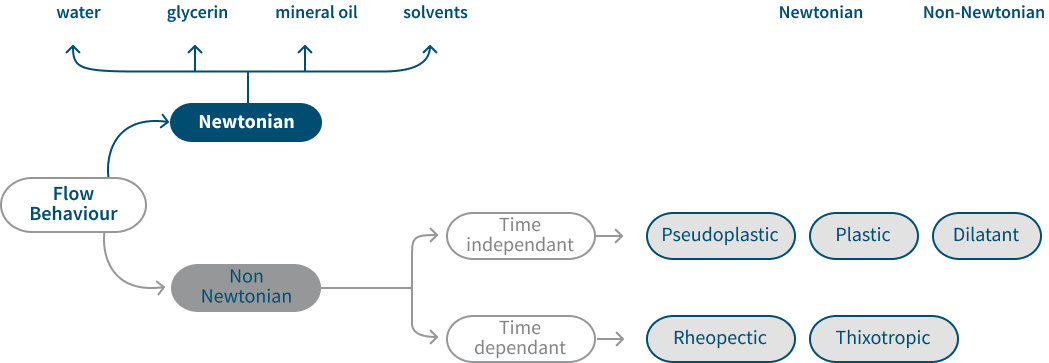
Rotational Viscometer
The viscosity is calculated from the measured torque and rotational speed, as well as the dimensions of the measuring geometry.
A fluid’s resistance to flow is measured by the torque it exerts on the rotating shaft of the viscometer.
Absolute viscosity: the measuring geometry fulfills certain requirements (which is the case of coaxial spindles).
Relative viscosity: the dimensions of the measuring geometry are not well defined.
Advantage
Flexibility in:
- Viscosity Range
- Temperature range
- Shear rate range
Application
For Newtonian and non-Newtonian substances and temperatures different from room temperature.
Glass capillary viscometers for transparent Newtonian liquids
The Cannon-Fenske Routine viscometer is specifically designed for measuring the kinematic viscosity of transparent Newtonian liquids. Its simple capillary design offers excellent repeatability, making it a preferred solution for routine laboratory testing and industrial quality control.
Manufactured from precision borosilicate glass, each viscometer is individually calibrated to provide reliable and traceable viscosity measurements throughout its service life.
International testing standards
Fungilab Cannon-Fenske Routine viscometers comply with internationally recognised viscosity testing standards, including:
- ASTM D445
- ASTM D446
- ISO 3104
- ISO 3105
- UNE 400313
Main features
- Designed for transparent Newtonian liquids.
- Precision borosilicate glass construction.
- Excellent measurement repeatability.
- Individual calibration certificate included.
- Suitable for laboratory quality control and research.
Calibration and traceability
Every Cannon-Fenske Routine viscometer is individually calibrated under the requirements of a National Metrological Register, ensuring measurement traceability and confidence for laboratory testing.
For optimum measurement accuracy, viscosity tests should be performed under controlled temperature conditions. The THERMOCAP precision bath provides the temperature stability required for accurate capillary viscosity measurements.
Alternative capillary viscometers
When testing dark or opaque Newtonian liquids, the Cannon-Fenske Opaque reverse-flow models provide the appropriate solution. Fungilab also manufactures BS/U-Tube viscometers for transparent liquids, BS/IP/RF U-Tube viscometers for opaque liquids and Ubbelohde viscometers for different laboratory requirements.
Typical applications
Cannon-Fenske Routine viscometers are widely used for measuring the kinematic viscosity of lubricants, petroleum products, solvents, chemicals and many other transparent Newtonian liquids in laboratory and industrial environments.
Fungilab can recommend the most suitable viscometer constant according to the expected viscosity range, sample characteristics and applicable testing standard.
Frequently asked questions about the Viscolead ADV
What is a Cannon-Fenske Routine viscometer?
It is a glass capillary viscometer designed for measuring the kinematic viscosity of transparent Newtonian liquids in laboratory and quality control applications.
Which samples are suitable for Cannon-Fenske Routine viscometers?
They are intended for transparent Newtonian liquids such as lubricants, petroleum products, solvents and many chemical products.
Which standards does the Cannon-Fenske Routine comply with?
Fungilab Cannon-Fenske Routine viscometers comply with ASTM D445, ASTM D446, ISO 3104, ISO 3105 and UNE 400313.
Does each viscometer include a calibration certificate?
Yes. Every Cannon-Fenske Routine viscometer is individually calibrated and supplied with its own calibration certificate to provide measurement traceability.
What is the difference between Cannon-Fenske Routine and Cannon-Fenske Opaque?
Cannon-Fenske Routine viscometers are intended for transparent Newtonian liquids, while Cannon-Fenske Opaque models feature a reverse-flow design for dark or opaque liquids.
Why is temperature control important during viscosity measurements?
Kinematic viscosity changes with temperature, making stable thermal conditions essential for obtaining accurate and repeatable results.
Can Cannon-Fenske Routine viscometers be used for quality control?
Yes. They are widely used in quality control laboratories, research centres and industrial testing facilities where repeatable viscosity measurements are required.
Which other capillary viscometers are available from Fungilab?
Fungilab also offers Cannon-Fenske Opaque, BS/U-Tube, BS/IP/RF U-Tube and Ubbelohde capillary viscometers to cover a wide range of kinematic viscosity measurement applications.