PRODUCTS
Anton Paar rotational viscometers
+ infoLooking for Anton Paar rotational viscometers?
If you are evaluating Anton Paar rotational viscometers for laboratory testing, quality control or research applications, it is important to compare the measuring range, sample characteristics, temperature requirements, accessories and level of automation required for your tests.
Fungilab offers a complete range of rotational viscometers for dynamic viscosity measurement, designed to provide accurate, repeatable and reliable results in laboratory and industrial environments.
Available solutions include instruments for routine viscosity control, advanced laboratory testing and demanding research applications, together with accessories for low-viscosity liquids, small samples, non-flowing materials and high-temperature measurements.
Our products
Viscolead Series
Viscolead ONE
Viscolead ADV
Accessories
LABORATORY DIVISION
Dynamic viscosity
Viscosity is part of the science of Rheology which quantifies the resistance materials give to changing shape.
Proper interpretation of viscosity data can reduce the rate of rejects while keeping production and formulation development costs to a minimum. Consistent product quality is ensured through proper viscosity measurements, either alone or in conjunction with compatible tests.
Dynamic viscosity testing can help with:
- Material characterization or “finger-printing”
- Standard testing methods to check for differences between batches
- Indirect way of measuring quality
- Product formulation
- Quality control
- Process control
- Design, optimization and operation of process equipment
Material characterization or “finger-printing”
Standard testing methods to check for differences between batches
Indirect way of measuring quality
Product formulation
Quality control
Process control
Design, optimization and operation of process equipment
Viscosity types
Dynamic viscosity
Centipoise (mPa*s)
Kinematic viscosity
Centistokes (mm2/sec)
Apparent viscosity
Centipoise (mPa*s)
Newton’s Law
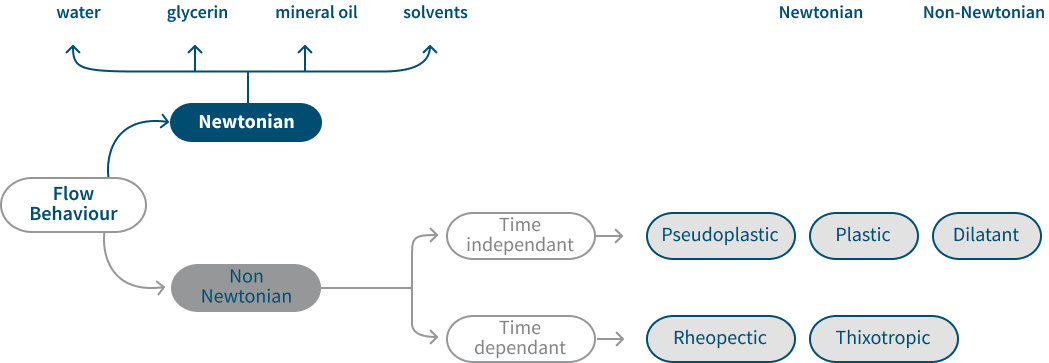
According to Newton’s law, the viscosity of a fluid is constant. As shear rate changes, shear stress changes in proportion such that viscosity is constant. Common fluids that exhibit such behavior are:
Unfortunately for us, not all fluids follow Newton’s law. In fact, most fluids do not. For this reason, fluids are classified into two categories:
Rotational Viscometer
The viscosity is calculated from the measured torque and rotational speed, as well as the dimensions of the measuring geometry.
A fluid’s resistance to flow is measured by the torque it exerts on the rotating shaft of the viscometer.
Absolute viscosity: the measuring geometry fulfills certain requirements (which is the case of coaxial spindles).
Relative viscosity: the dimensions of the measuring geometry are not well defined.
Advantage
Flexibility in:
- Viscosity Range
- Temperature range
- Shear rate range
Application
For Newtonian and non-Newtonian substances and temperatures different from room temperature.
Alternatives to Anton Paar rotational viscometers
When comparing alternatives to Anton Paar rotational viscometers, the instrument should be selected according to the expected viscosity range, required accuracy, spindle geometry, sample volume, operating temperature and the rheological behaviour of the material.
Rotational viscometers determine viscosity from the resistance generated when a spindle rotates inside the sample. The resulting measurement depends on torque, rotational speed and measuring geometry, making this method suitable for both Newtonian and non-Newtonian materials.
Fungilab rotational viscometer ranges
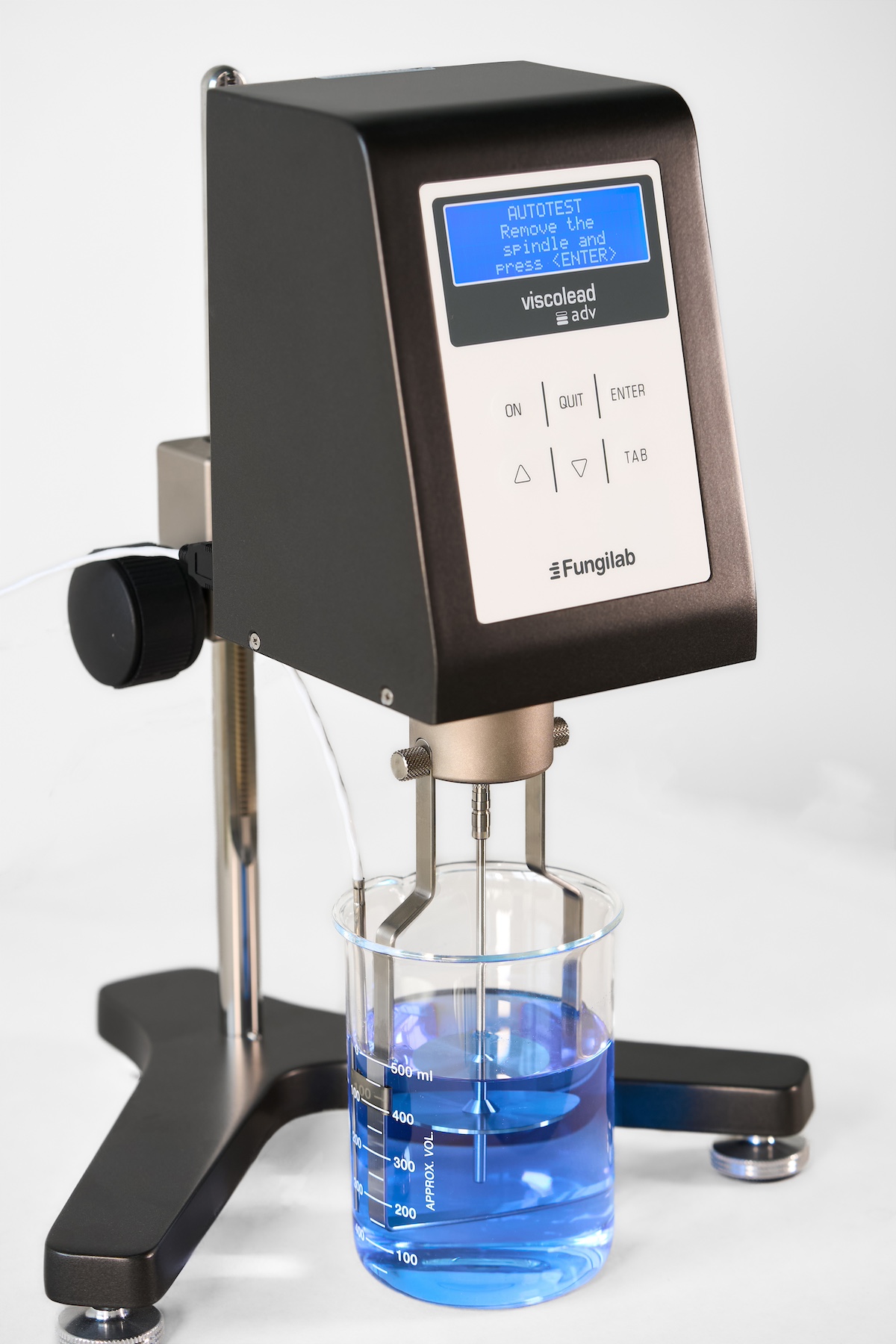
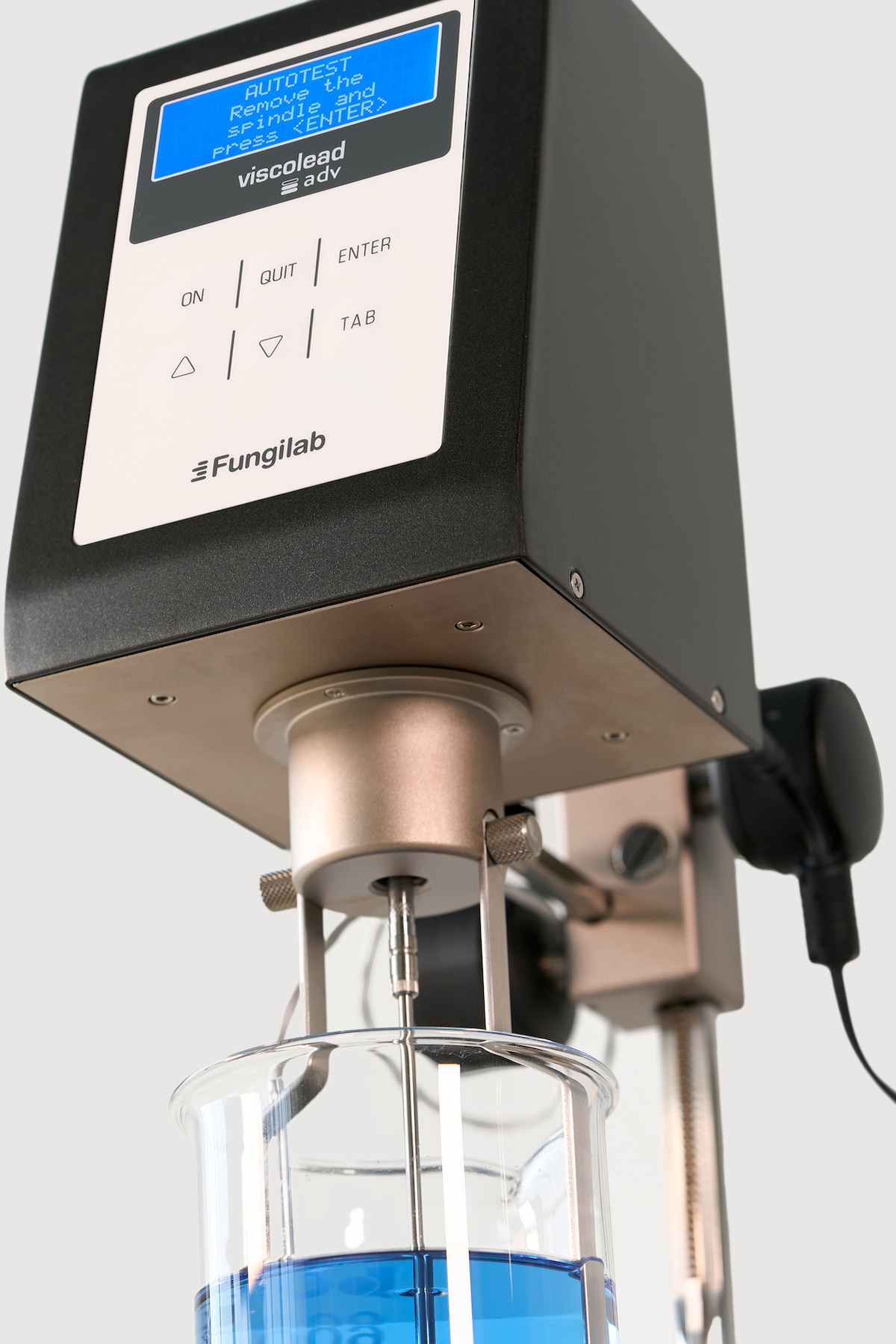
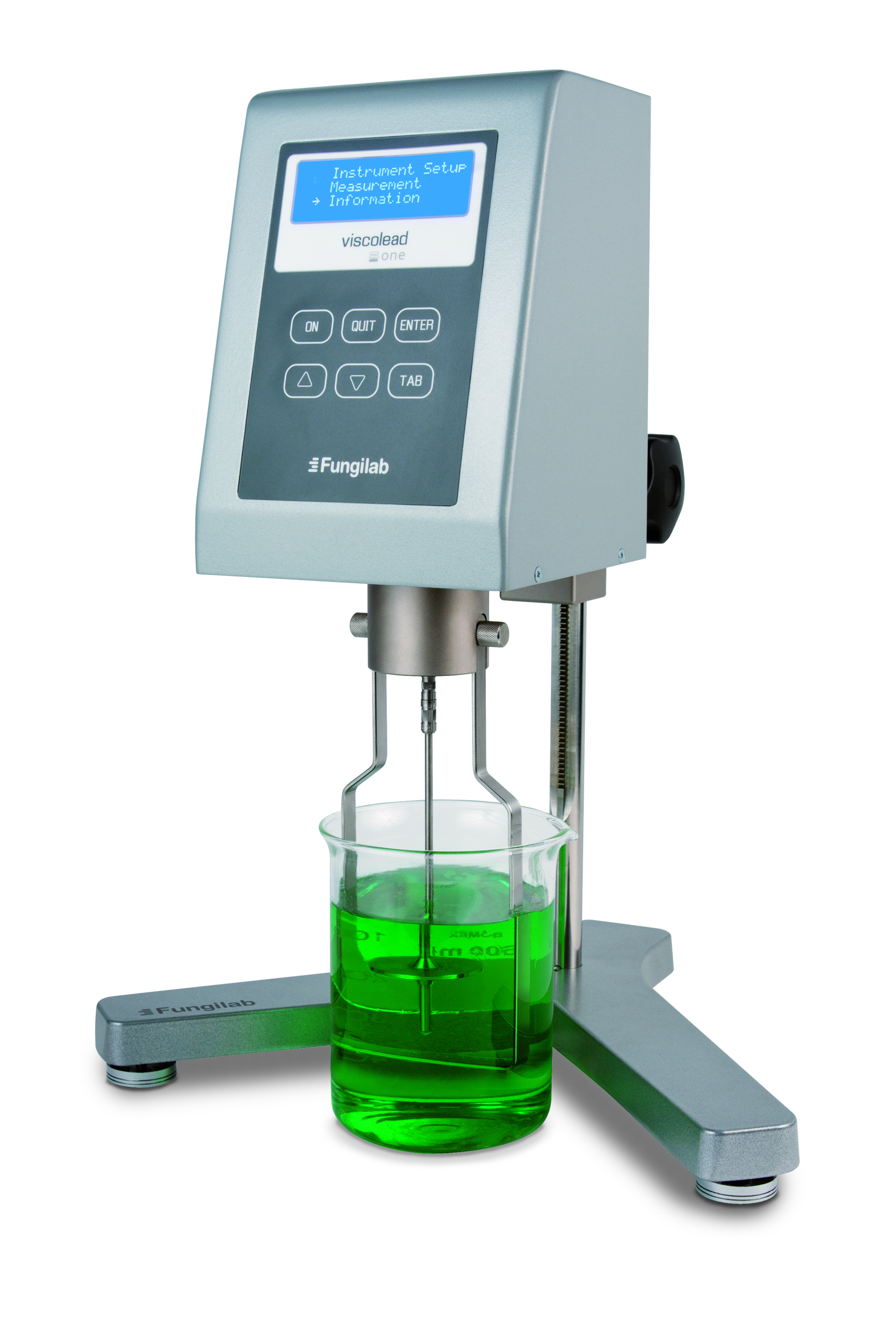
The Viscolead Series provides reliable rotational viscosity measurements for laboratories, quality control departments and research applications. These instruments combine precise measurement, intuitive operation, flexible spindle configuration and data management capabilities.
For more advanced applications, the Fungilab V-Series offers premium rotational viscometers with wireless operation, patented technology, a dedicated mobile application and an interface designed to improve laboratory productivity.
Accessories for different viscosity applications
A rotational viscometer can be adapted to different samples and testing conditions through specific accessories:
- Small Sample Adapter APM for precise measurements using sample volumes from approximately 8 to 13 ml.
- Low Viscosity Adapter LCP for liquids with viscosities starting from 1 cP.
- HELDAL Unit for creams, pastes, gels and other materials that do not flow easily.
- Thermosphere system for viscosity measurements at temperatures up to 300°C.
Temperature control and viscosity verification
Temperature has a direct influence on viscosity, so stable thermal conditions are essential for obtaining comparable and repeatable results. Fungilab provides heating circulators and refrigerated heating circulators for viscosity testing under controlled temperatures.
Measurement reliability can also be checked using certified viscosity standard oils, developed for calibration and verification of rotational viscometers and other laboratory viscosity instruments.
How to select the right rotational viscometer
Before selecting an instrument, define the lowest and highest expected viscosity, the available sample volume, the required measuring temperature and whether the material is Newtonian or non-Newtonian. It is also important to determine whether the application requires routine quality control, comparative batch testing, formulation development or more advanced rheological analysis.
Fungilab can help identify the most appropriate rotational viscometer and accessory configuration according to the characteristics of the sample and the testing requirements of each laboratory.
Frequently asked questions about the Viscolead ADV
What alternatives are available to Anton Paar rotational viscometers?
Fungilab offers different rotational viscometer ranges for routine quality control, laboratory testing, research and advanced viscosity applications. The most suitable alternative depends on the viscosity range, sample volume, measuring temperature and required level of automation.
How do I compare Anton Paar and Fungilab rotational viscometers?
The comparison should consider measuring range, torque sensitivity, available speeds, spindle compatibility, temperature control, sample volume, data management and the accessories required for the intended application.
Which Fungilab rotational viscometer is suitable for quality control?
The Viscolead Series is designed for reliable and repeatable viscosity measurements in quality control laboratories, production environments and research applications. The specific model should be selected according to the expected viscosity range and sample characteristics.
Can Fungilab rotational viscometers measure low-viscosity liquids?
Yes. The Low Viscosity Adapter LCP is designed for accurate and reproducible measurements of low-viscosity liquids, with a measuring range starting from approximately 1 cP.
Can small sample volumes be measured?
Yes. The Small Sample Adapter APM allows precise viscosity measurements using sample volumes from approximately 8 to 13 ml, depending on the selected spindle.
How can high-viscosity or non-flowing materials be measured?
The Fungilab HELDAL Unit is designed for materials such as creams, pastes and gels that cannot be measured reliably with conventional spindle configurations. It moves the viscometer head vertically so that the spindle travels through the sample in a helical path.
Can rotational viscosity be measured at controlled temperatures?
Yes. Fungilab offers heating circulators, refrigerated heating circulators and the Thermosphere high-temperature system for viscosity measurements under controlled thermal conditions.
How can the accuracy of a rotational viscometer be verified?
Viscometer performance can be checked using certified viscosity standard oils with known values at specified temperatures. These reference fluids help verify calibration, measurement accuracy and repeatability.