

PRODUCTS
Certified viscosity standard oils
Capillary viscometers for kinematic viscosity measurement
Capillary viscometers are precision glass instruments used to determine the kinematic viscosity of Newtonian liquids by measuring the time required for a fixed volume of liquid to flow through a calibrated capillary under the influence of gravity.
Fungilab offers a complete range of capillary viscometers manufactured according to internationally recognised ASTM, ISO and UNE standards, providing reliable, repeatable and traceable viscosity measurements for laboratories, research centres and industrial quality control.
Whether you require routine testing of transparent liquids or measurements on opaque samples, Fungilab provides the appropriate capillary viscometer together with precision temperature baths and calibration accessories.
Our accessories
Enhance the capabilities of your Fungilab viscometer with accessories designed for more accurate, versatile and efficient viscosity measurements.
Viscosity Standard Oils
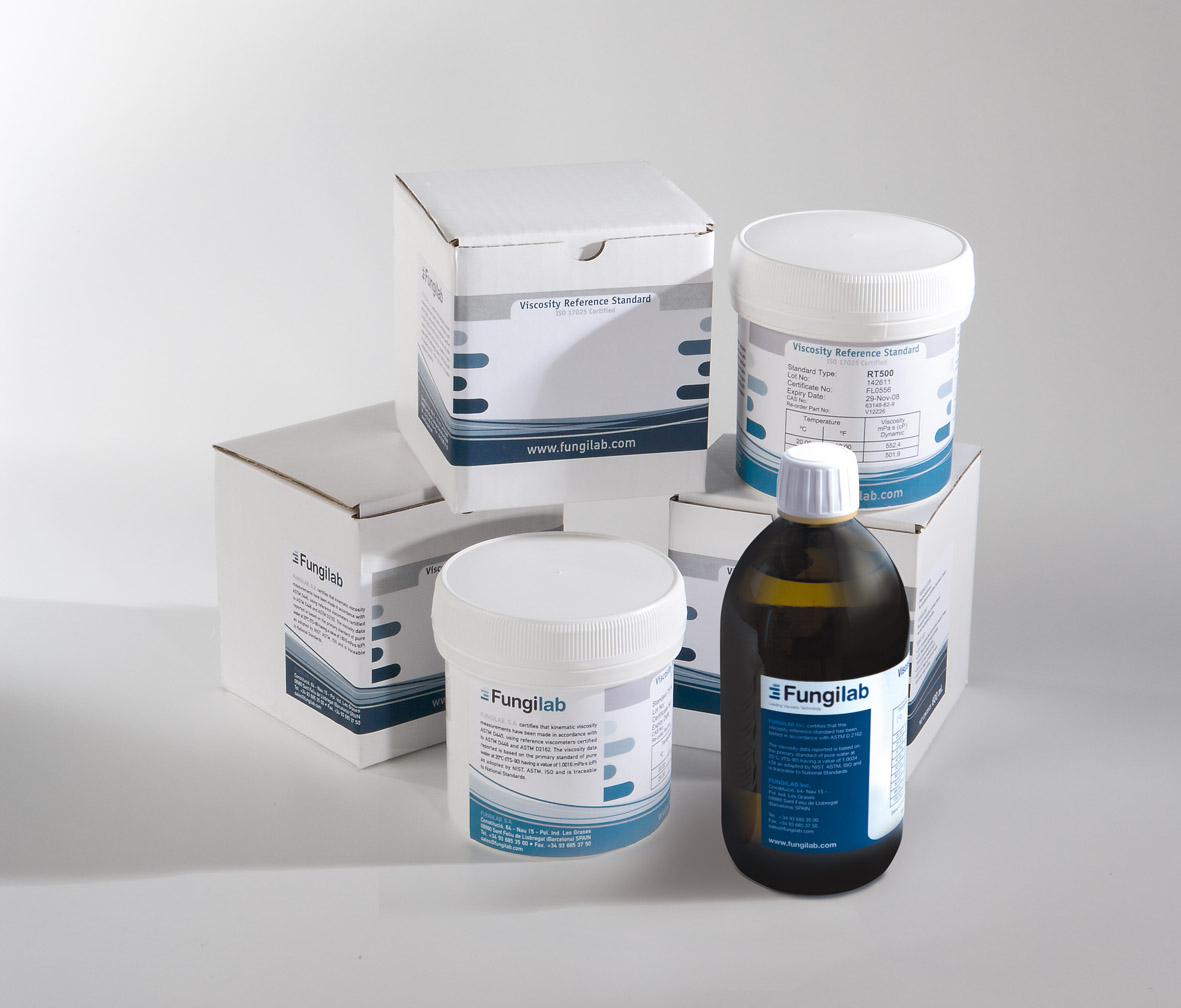
Certified viscosity standards
Fungilab offers a wide variety of certified viscosity standards for the calibration and verification of glass capillary viscometers, auto viscometers, rotational viscometers, flow cups and other viscosity measuring equipment.
Viscosity plays a critical role in the performance in different fields. Using a certified viscosity standard is essential for precise calibration and verification of viscosity measurements, ensuring the accuracy and reliability of analytical instrumentation.
All viscosity standards are traceable to the primary standard of pure water, having a Kinematic Viscosity of 1.0034 mm2/s at 20 °C, as adopted by National Metrology Laboratories such as NIST and national standard bodies like ASTM, IP and ISO. All certification is carried out in accordance with ISO 17025 and ISO 17034 accreditations.
General purpose viscosity standards
Fungilab ISO 17025 / ISO Guide 34 dual certified general purpose viscosity standards are tested in accordance with ASTM D 2162, (“Standard Practice for basic calibration of master viscometers and viscosity standard oils”).
They are fully traceable to national standards and are test equipment compatible.
- Certified according to ISO 17025 / ISO Guide 34 under UKAS accreditation
- Tested in accordance with ASTM D 2162 (“Standard Practice for basic calibration of master viscometers and viscosity standard oils”)
- Density g/mL in accordance with ASTM D 1480
- Kinematic (cSt), Dynamic Viscosity (mPa•s) & Density (g/mL) given at all temperatures
- Standard Pack Size 600mL, available also in 5L, 10L and 20L
- Fully traceable to national standards
- Ensures full compliance to ASTM & IP test method protocol
- Tamper evident security packaging
- Holographically marked to assure authenticity
Flow cup viscosity standards
Fungilab ISO 17025 / ISO Guide 34 dual certified flow cup standards are especially designed for use in DIN, Ford, ISO, Shell and Zahn flow cups and are also dual purpose density standards.
Certified at 20°C and 25°C, each value is tested to ASTM D 2162 for viscosity measurement and ASTM D 1480 for density measurement. Each value at every test temperature is tested to ASTM D 2162 and are NOT extrapolations.
- Certified according to ISO 17025 / ISO Guide 34 under UKAS accreditation
- Tested in accordance with ASTM D 2162 (“Standard Practice for basic calibration of master viscometers and viscosity standard oils”)
- Density g/mL in accordance with ASTM D 1480
- Kinematic (cSt), Dynamic Viscosity (mPa•s) & Density (g/mL) quoted at all temperatures
- Ensures full compliance to ASTM & IP test method protocol
- Full traceability to national standards
- Tamper evident security packaging
- Holographically marked to assure authenticity
General purpose silicone standards
Fungilab ISO 17025 / ISO 17034 dual certified Silicone Rotational Viscosity Standards are specifically formulated for use with rotational viscometers. Supplied in 600 mL ‘ready to use’ packs specially designed to eliminate the requirement to transfer the sample to a test beaker. Silicone viscosity standard fluids are most commonly used to verify calibration of Fungilab lab viscometers.
General purpose silicone fluids are the most commonly used standard for verifying calibration of your Fungilab Viscometer. Silicone Standards are Newtonian fluids which are accurate to ±1% of viscosity value. Silicone fluids provide excellent temperature stability. Fungilab Viscosity Standards are certified by methods traceable to the United States National Institute of Standards and Technology (NIST).
Key benefits
- Certified according to ISO 17025 / ISO 17034 under UKAS accreditation
- 600 mL of product supplied in a ready to use ‘test in pack’ container
- Tested and certified at 20°C and 25°C
- 24 month shelf life
- Ensures full compliance to international test method protocol
- Full traceability to national standards
LABORATORY DIVISION
Dynamic viscosity
Viscosity is part of the science of Rheology which quantifies the resistance materials give to changing shape.
Proper interpretation of viscosity data can reduce the rate of rejects while keeping production and formulation development costs to a minimum. Consistent product quality is ensured through proper viscosity measurements, either alone or in conjunction with compatible tests.
Dynamic viscosity testing can help with:
- Material characterization or “finger-printing”
- Standard testing methods to check for differences between batches
- Indirect way of measuring quality
- Product formulation
- Quality control
- Process control
- Design, optimization and operation of process equipment
Material characterization or “finger-printing”
Standard testing methods to check for differences between batches
Indirect way of measuring quality
Product formulation
Quality control
Process control
Design, optimization and operation of process equipment
Viscosity types
Dynamic viscosity
Centipoise (mPa*s)
Kinematic viscosity
Centistokes (mm2/sec)
Apparent viscosity
Centipoise (mPa*s)
Newton’s Law
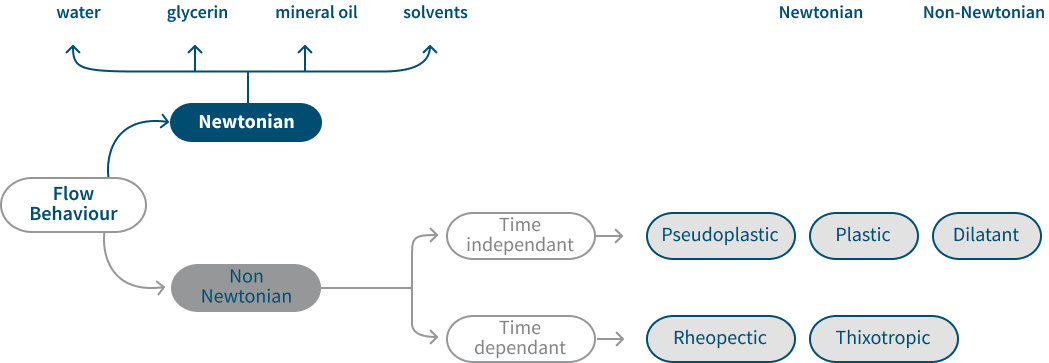
According to Newton’s law, the viscosity of a fluid is constant. As shear rate changes, shear stress changes in proportion such that viscosity is constant. Common fluids that exhibit such behavior are:
Unfortunately for us, not all fluids follow Newton’s law. In fact, most fluids do not. For this reason, fluids are classified into two categories:
Rotational Viscometer
The viscosity is calculated from the measured torque and rotational speed, as well as the dimensions of the measuring geometry.
A fluid’s resistance to flow is measured by the torque it exerts on the rotating shaft of the viscometer.
Absolute viscosity: the measuring geometry fulfills certain requirements (which is the case of coaxial spindles).
Relative viscosity: the dimensions of the measuring geometry are not well defined.
Advantage
Flexibility in:
- Viscosity Range
- Temperature range
- Shear rate range
Application
For Newtonian and non-Newtonian substances and temperatures different from room temperature.
Reference oils for viscosity calibration and instrument verification
Certified viscosity standard oils are essential laboratory reference materials used to verify the accuracy and repeatability of viscosity measurement instruments. Each oil has a certified viscosity value determined under controlled conditions, allowing laboratories to confirm that their instruments continue to operate within specification.
Routine verification using certified reference oils is considered good laboratory practice and helps ensure measurement consistency, instrument reliability and long-term traceability.
Applications of certified viscosity standard oils
Certified reference oils are commonly used for:
- Routine instrument verification.
- Performance qualification.
- Quality assurance procedures.
- Preventive maintenance.
- Calibration checks.
- Laboratory accreditation support.
Compatible with rotational and capillary viscometers
Fungilab certified viscosity standard oils are suitable for verifying a wide range of viscosity measurement systems, including rotational viscometers and glass capillary viscometers.
They are commonly used to verify instruments such as the Viscolead Series, V-Series, as well as Cannon-Fenske, BS/U-Tube and Ubbelohde capillary viscometers.
Reliable laboratory measurements
Using certified reference oils at regular intervals allows laboratories to detect instrument deviations before they affect production or research results. This contributes to better measurement reliability, reduced uncertainty and improved confidence in reported viscosity values.
Since viscosity is strongly influenced by temperature, certified oils should always be used together with appropriate temperature control equipment such as the THERMOCAP precision bath for capillary viscometers or suitable temperature control systems for rotational viscosity measurements.
Available viscosity ranges
Fungilab offers certified viscosity standard oils covering a broad range of viscosity values, enabling laboratories to verify instruments operating from very low to very high viscosities. This allows each laboratory to select the reference fluid that best matches its routine testing conditions.
Industries using certified reference oils
Certified viscosity standard oils are widely used in petroleum, lubricant, chemical, pharmaceutical, cosmetic, food and research laboratories where viscosity measurement accuracy and traceability are essential.
Frequently asked questions about Certified viscosity standard oils
What are certified viscosity standard oils?
Certified viscosity standard oils are reference fluids with known viscosity values used to verify and validate the performance of viscosity measurement instruments.
Why are certified viscosity standard oils important?
They help laboratories verify instrument accuracy, improve measurement repeatability and maintain traceability throughout routine testing.
Can certified viscosity standard oils be used with rotational viscometers?
Yes. They are widely used to verify the performance of rotational viscometers operating across different viscosity ranges.
Are certified viscosity standard oils suitable for capillary viscometers?
Yes. They are commonly used to verify glass capillary viscometers such as Cannon-Fenske, BS/U-Tube and Ubbelohde models.
How often should viscosity standard oils be used?
The verification frequency depends on laboratory quality procedures, instrument usage and accreditation requirements, but regular routine checks are recommended.
Does temperature affect certified viscosity standard oils?
Yes. Their certified viscosity values are valid at specified temperatures, so accurate temperature control is essential during verification.
Which industries use certified viscosity standard oils?
They are widely used in petroleum, chemical, pharmaceutical, cosmetic, food and research laboratories requiring accurate viscosity measurements.
Can certified viscosity standard oils support laboratory accreditation?
Yes. Routine verification with certified reference oils helps demonstrate measurement traceability and supports laboratory quality management systems.
