PRODUCTS
HELDAL Unit for high viscosity materials
+ infoDynamic viscosity measurement for laboratory and industrial applications
Dynamic viscosity measurement is essential for evaluating how liquids and semi-solid materials resist flow under applied force. Accurate viscosity data supports product development, quality control and process optimisation across a wide range of industries.
Fungilab provides complete dynamic viscosity measurement solutions based on precision rotational viscometers, temperature control systems and specialized accessories designed to deliver reliable, repeatable and traceable laboratory results.
Whether measuring low-viscosity liquids or highly viscous materials, Fungilab offers instruments adapted to routine laboratory testing as well as demanding research applications.
Our products
Viscolead Series
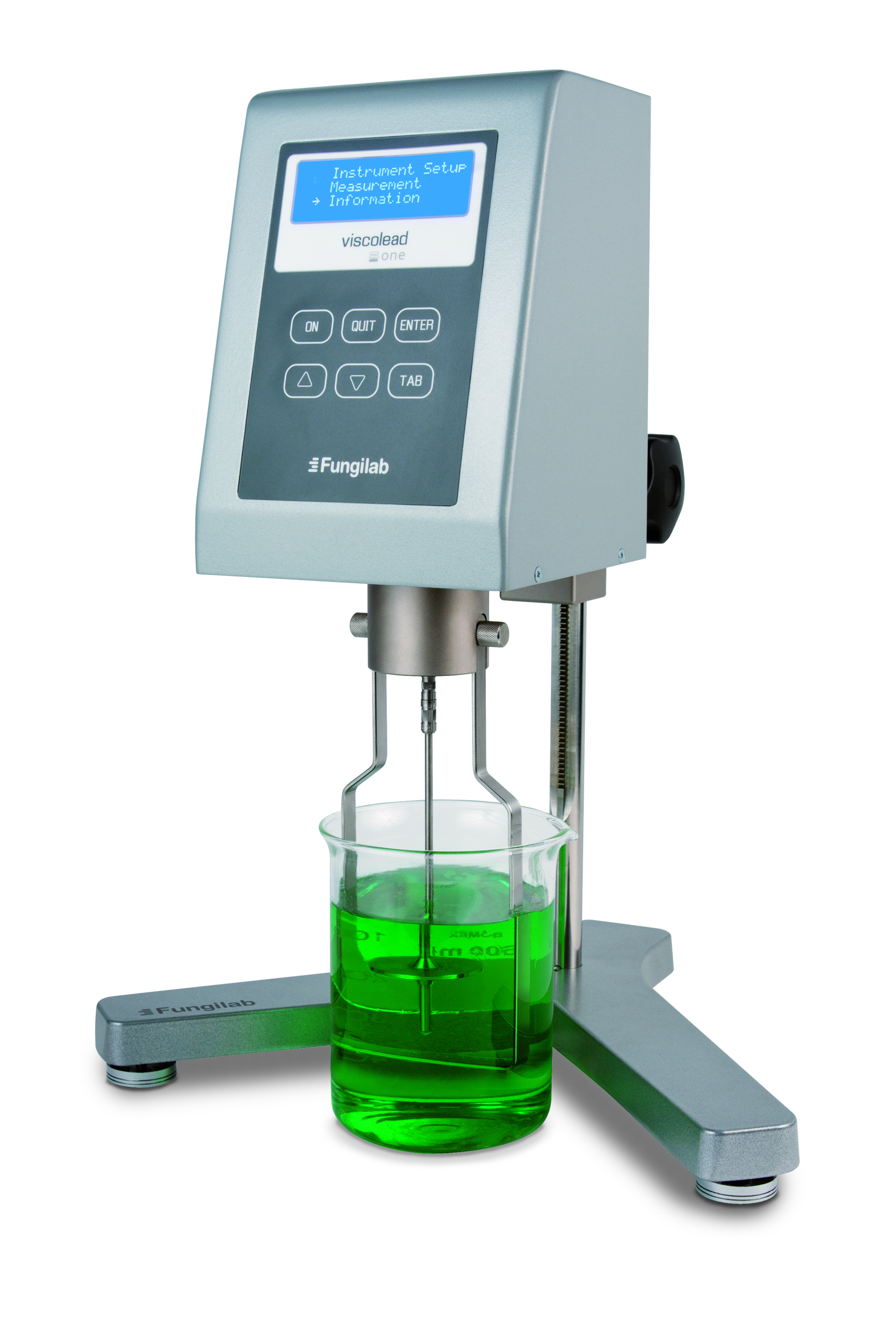
Viscolead ONE
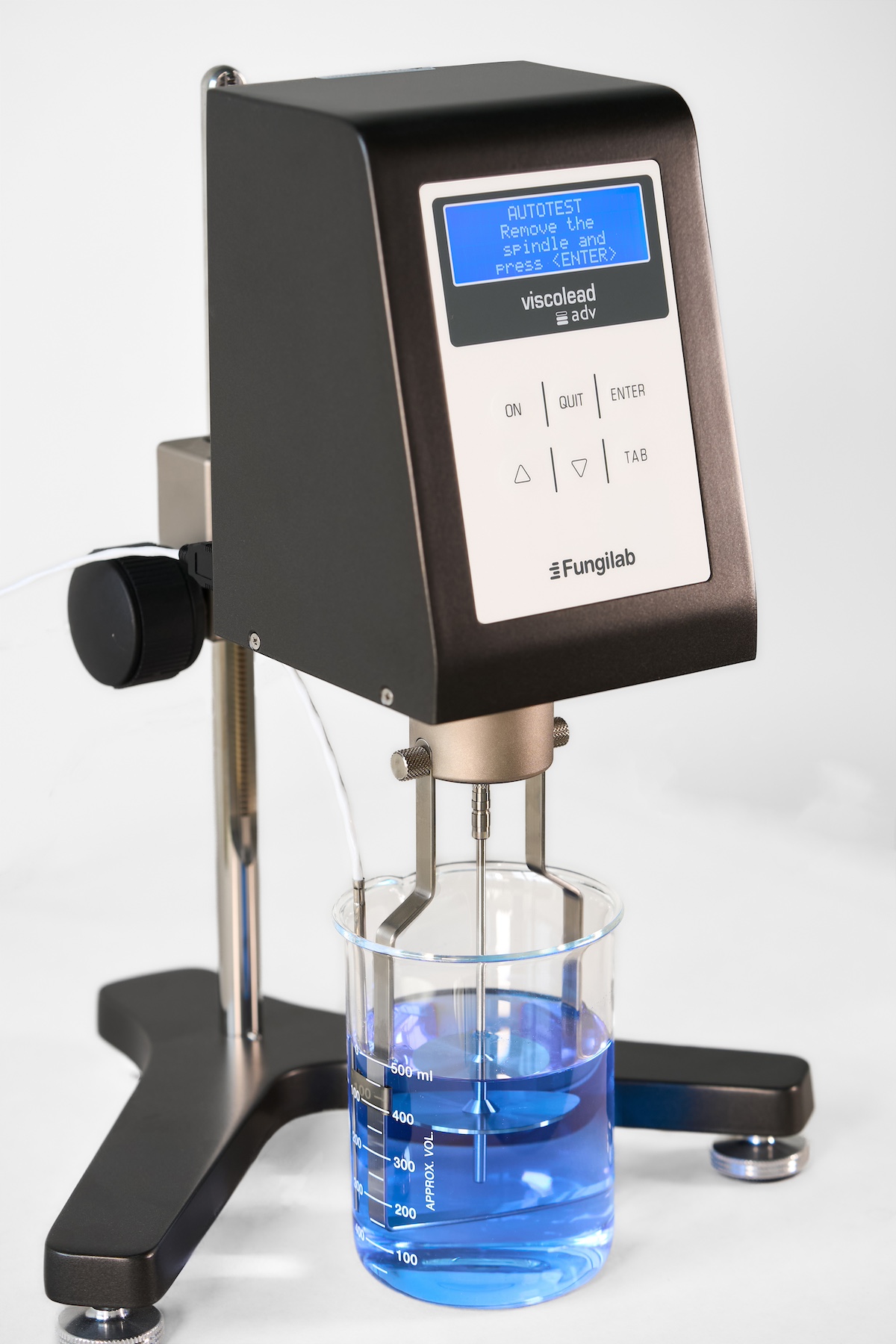
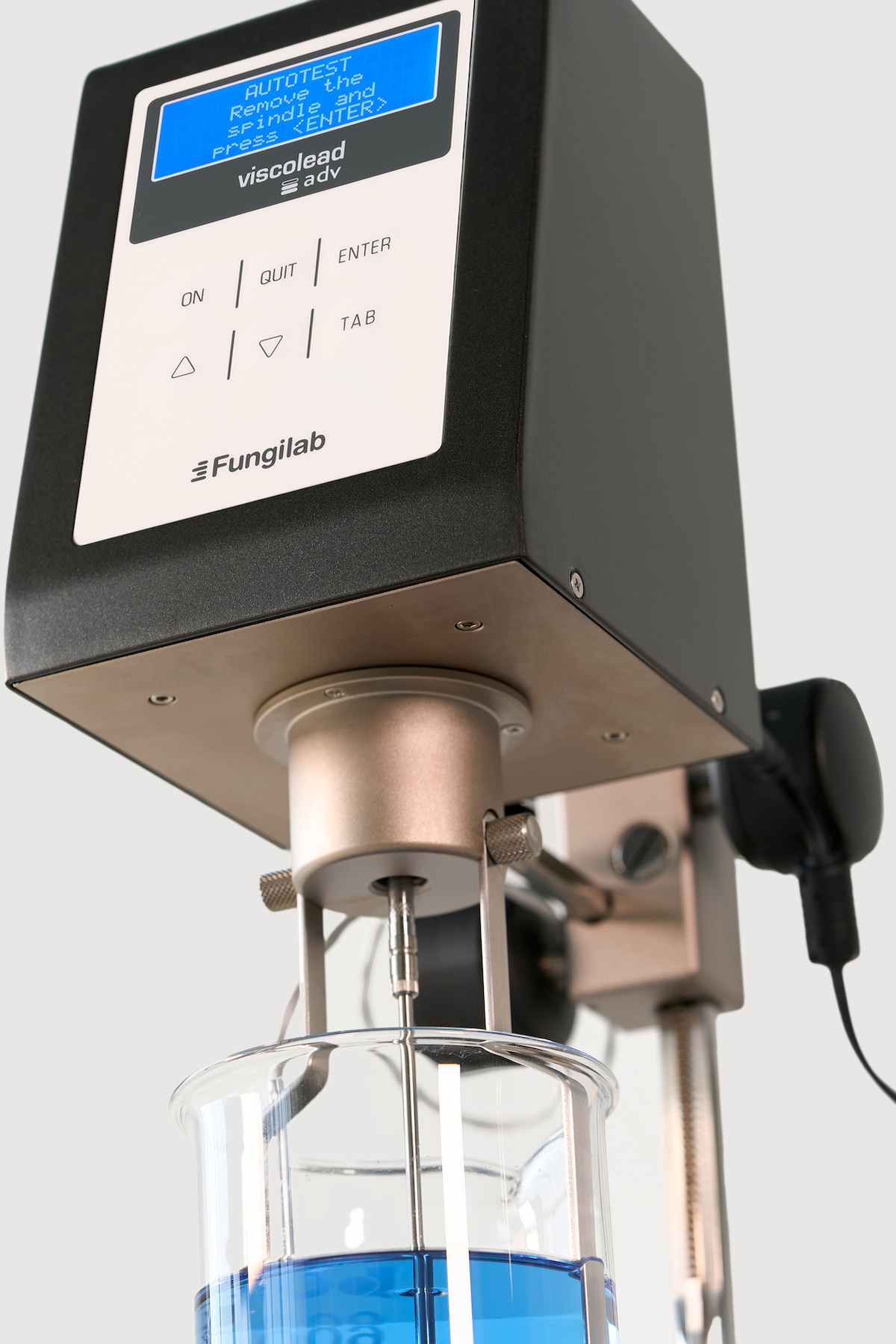
Viscolead ADV
Accessories
LABORATORY DIVISION
Dynamic viscosity
Viscosity is part of the science of Rheology which quantifies the resistance materials give to changing shape.
Proper interpretation of viscosity data can reduce the rate of rejects while keeping production and formulation development costs to a minimum. Consistent product quality is ensured through proper viscosity measurements, either alone or in conjunction with compatible tests.
Dynamic viscosity testing can help with:
- Material characterization or “finger-printing”
- Standard testing methods to check for differences between batches
- Indirect way of measuring quality
- Product formulation
- Quality control
- Process control
- Design, optimization and operation of process equipment
Material characterization or “finger-printing”
Standard testing methods to check for differences between batches
Indirect way of measuring quality
Product formulation
Quality control
Process control
Design, optimization and operation of process equipment
Viscosity types
Dynamic viscosity
Centipoise (mPa*s)
Kinematic viscosity
Centistokes (mm2/sec)
Apparent viscosity
Centipoise (mPa*s)
Newton’s Law
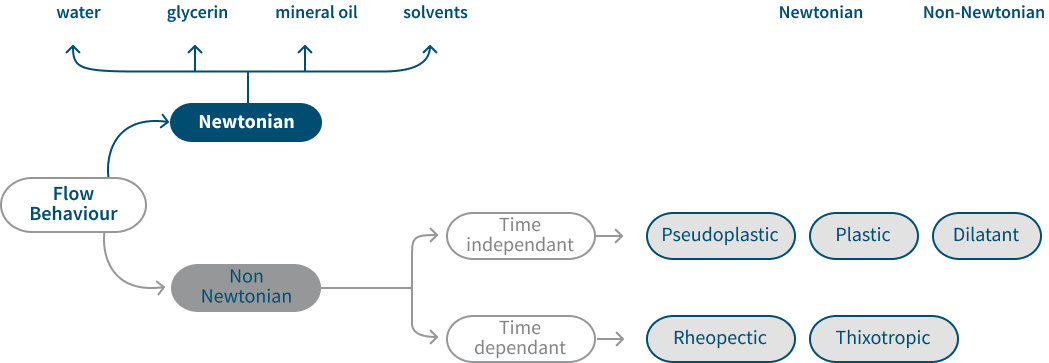
According to Newton’s law, the viscosity of a fluid is constant. As shear rate changes, shear stress changes in proportion such that viscosity is constant. Common fluids that exhibit such behavior are:
Unfortunately for us, not all fluids follow Newton’s law. In fact, most fluids do not. For this reason, fluids are classified into two categories:
Rotational Viscometer
The viscosity is calculated from the measured torque and rotational speed, as well as the dimensions of the measuring geometry.
A fluid’s resistance to flow is measured by the torque it exerts on the rotating shaft of the viscometer.
Absolute viscosity: the measuring geometry fulfills certain requirements (which is the case of coaxial spindles).
Relative viscosity: the dimensions of the measuring geometry are not well defined.
Advantage
Flexibility in:
- Viscosity Range
- Temperature range
- Shear rate range
Application
For Newtonian and non-Newtonian substances and temperatures different from room temperature.
Professional solution for extremely high viscosity measurements
The HELDAL Unit has been developed to extend the measurement capabilities of Fungilab rotational viscometers when analysing highly viscous products that cannot flow freely around standard measuring spindles.
Unlike conventional spindle systems, the HELDAL Unit uses a helical spindle that slowly rotates while travelling vertically through the sample. This movement continuously exposes fresh material to the spindle, reducing channel formation and producing more representative viscosity measurements.
How the HELDAL Unit works
The combination of rotational movement and controlled vertical displacement allows the spindle to move through dense materials while maintaining constant contact with the sample. This measuring principle makes the HELDAL Unit particularly effective for products with extremely high consistency or poor flow characteristics.
Typical applications
- Cosmetic creams.
- Pharmaceutical ointments.
- Adhesives.
- Sealants.
- Silicones.
- Pastes.
- Heavy gels.
- Food products with high consistency.
Compatible Fungilab viscometers
The HELDAL Unit is compatible with several Fungilab rotational viscometers, including the Viscolead Series and the V-Series, providing laboratories with a complete solution for difficult high-viscosity measurements.
Advantages of the HELDAL Unit
- Measures materials that cannot be tested using standard spindles.
- Minimises channeling during measurement.
- Improves repeatability with highly viscous products.
- Suitable for non-flowing and semi-solid materials.
- Expands the measuring capabilities of rotational viscometers.
Temperature control for demanding applications
Where viscosity measurements must be performed under controlled thermal conditions, the HELDAL Unit can be used together with Fungilab heating circulators and refrigerated circulators, depending on the application.
Reliable and traceable measurements
For laboratories operating under quality management systems, instrument performance can be routinely verified using certified viscosity standard oils, helping maintain accurate and traceable viscosity measurements across the complete Fungilab product range.
Frequently asked questions about the Viscolead ADV
What is the HELDAL Unit?
The HELDAL Unit is a specialized accessory for Fungilab rotational viscometers designed to measure highly viscous, paste-like and non-flowing materials.
How does the HELDAL Unit work?
It uses a helical spindle that rotates while moving vertically through the sample, continuously measuring fresh material and reducing channeling effects.
Which products can be measured with the HELDAL Unit?
It is suitable for creams, ointments, gels, sealants, adhesives, silicones, heavy pastes and other highly viscous or semi-solid materials.
Why use the HELDAL Unit instead of standard spindles?
Standard spindles may create channels in very thick materials, while the HELDAL Unit continuously moves through the sample to provide more representative viscosity measurements.
Which Fungilab viscometers are compatible with the HELDAL Unit?
The HELDAL Unit is compatible with several Fungilab rotational viscometers, including the Viscolead Series and V-Series.
Can measurements be performed under controlled temperature conditions?
Yes. The HELDAL Unit can be combined with Fungilab heating or refrigerated circulators whenever temperature control is required.
Which industries commonly use the HELDAL Unit?
It is widely used in the cosmetic, pharmaceutical, food, chemical and adhesive industries for measuring products with extremely high viscosity.
How can the performance of the viscometer be verified?
Routine verification using certified viscosity standard oils helps ensure accurate, repeatable and traceable viscosity measurements.